Book a Demo
On-Demand Webinar

Billed Isn't Collected: A CEO's Guide to Closing the Revenue Gap

For owner/operators, finance, marketing & admissions leaders
$937Krecovered in one year by one operator
~30%of treatment days went uncollected before visibility
~60%fewer denials after fixing COB and AOR gaps

Most behavioral health operators don't have a clean, current view of what they've earned versus what they've collected.

Watch this session for a concrete look at financial clarity inside a behavioral health facility, and how top-performing operators close the gap between what they've earned and what they've collected.

Watch On Demand
The Short Version

In behavioral health, what you bill and what you collect are rarely the same number, and the gap is where margins quietly erode. Panelists reported roughly 30% of treatment days going unreimbursed before they had claim-level visibility, with denials driven by outdated coordination-of-benefits records and incorrect authorization forms. The fix is daily, claim-by-claim visibility into what was billed, allowed, denied, and paid, so problems surface while the patient is still in care and before timely-filing deadlines close.

Session highlights

Watch key moments

Short clips from the session. Fill out the form above to watch the full recording.
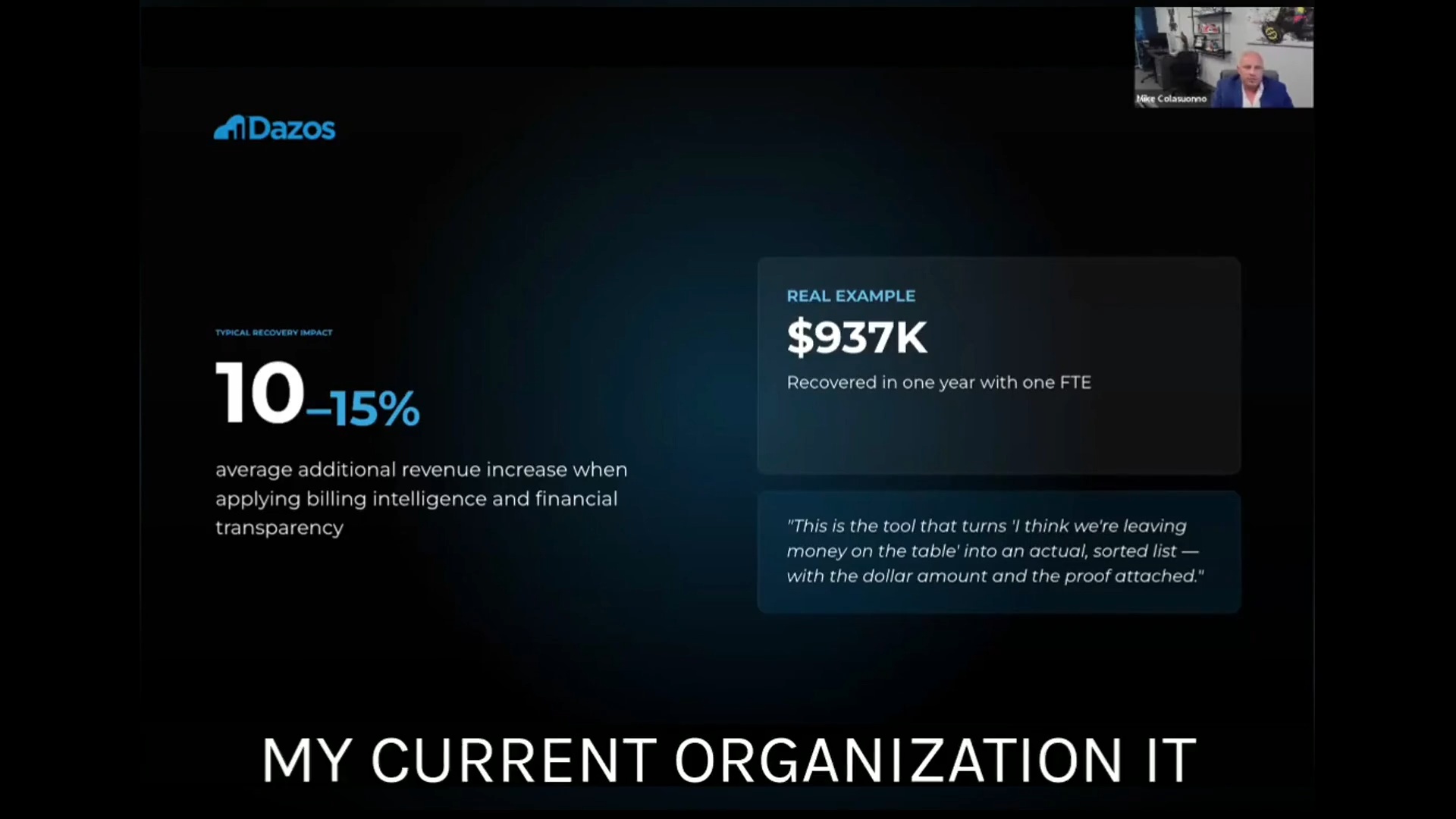
2:05
IQ Webinar - Diagnosing Trends & Preventing Denials

Recover the money, then prevent the next loss

Mike Colasuonno explains how Dazos IQ helped his team recover denied claims and spot the trends behind them, so the same losses stop repeating. He also shows how he uses his own billing data to fact-check his billing company's AR reports.
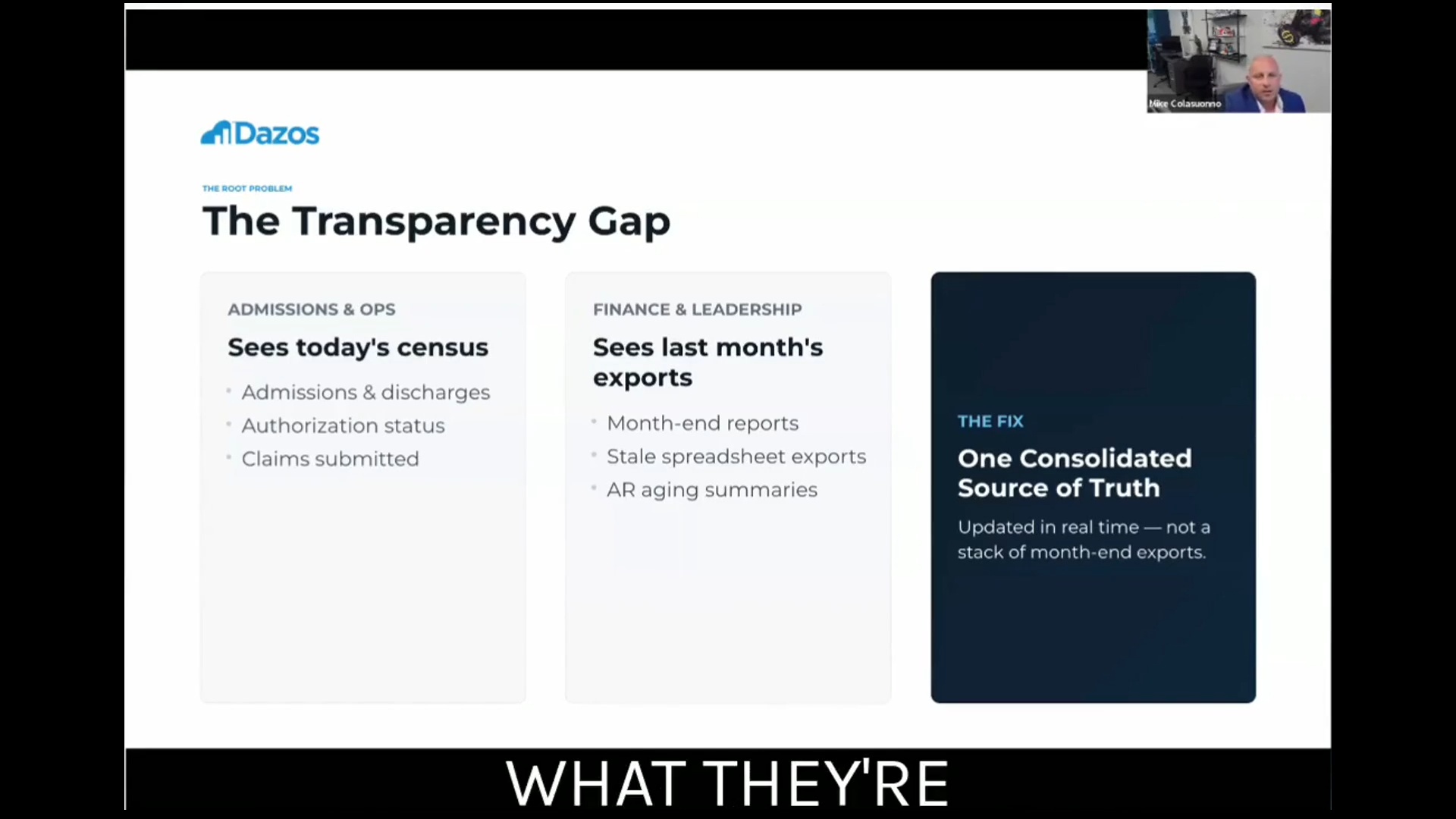
1:30
IQ Webinar - Daily Usage & Visibility

An hour a day in the claims data

Mike spends an hour or two in Dazos IQ every day, reviewing claims as they come in and tracking what each payer allows. He walks through hiring one person to keep coordination-of-benefits and authorization forms clean, a fix that cut his denials by about 60%.
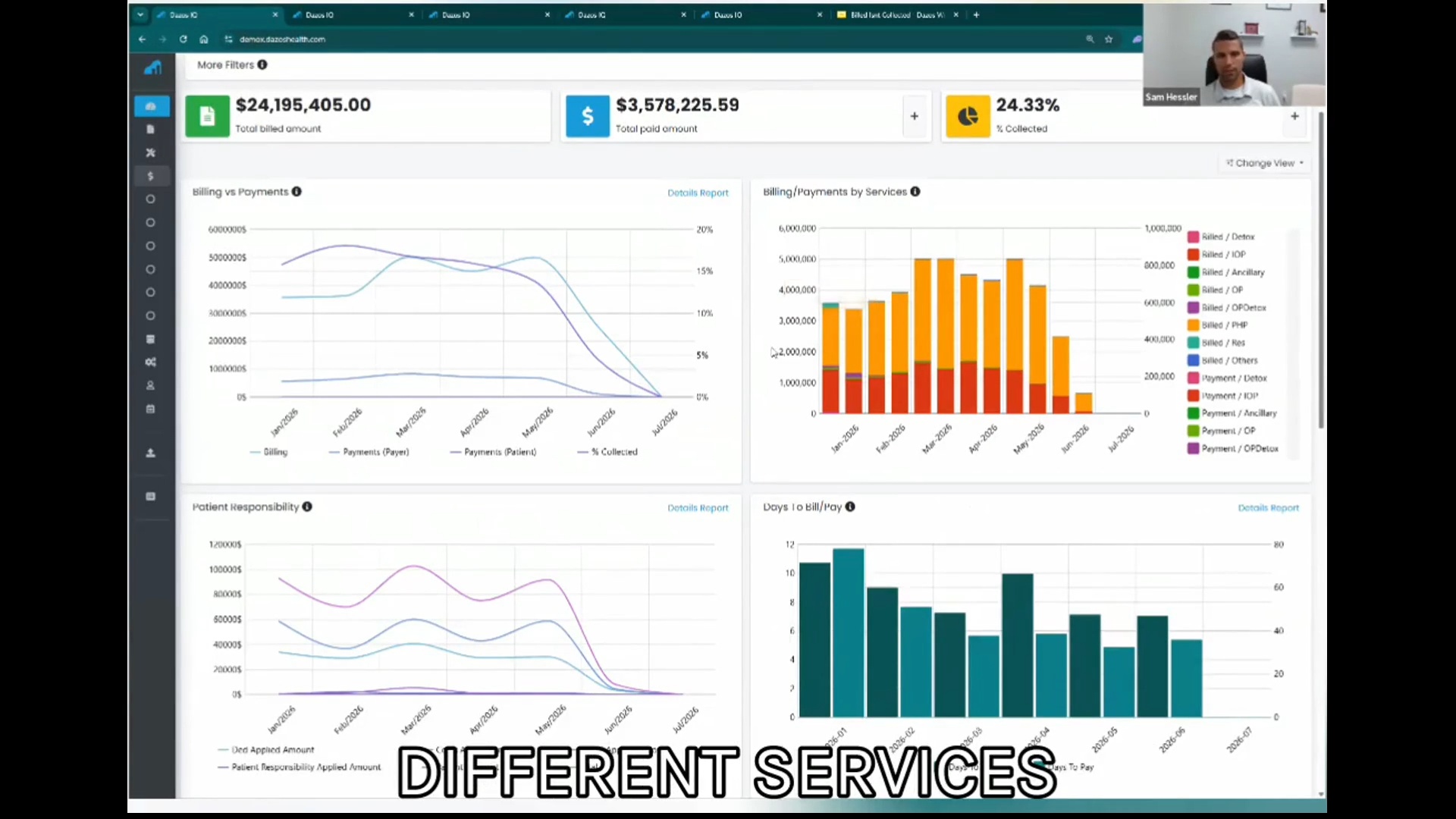
2:03
IQ Demo - Platform Overview

Your full revenue picture in one view

A walkthrough of the Dazos IQ dashboard: billings and payments over time, patient responsibility as it accrues, and how long claims take to bill and get paid. Drill into any single claim, note, or denial in seconds.
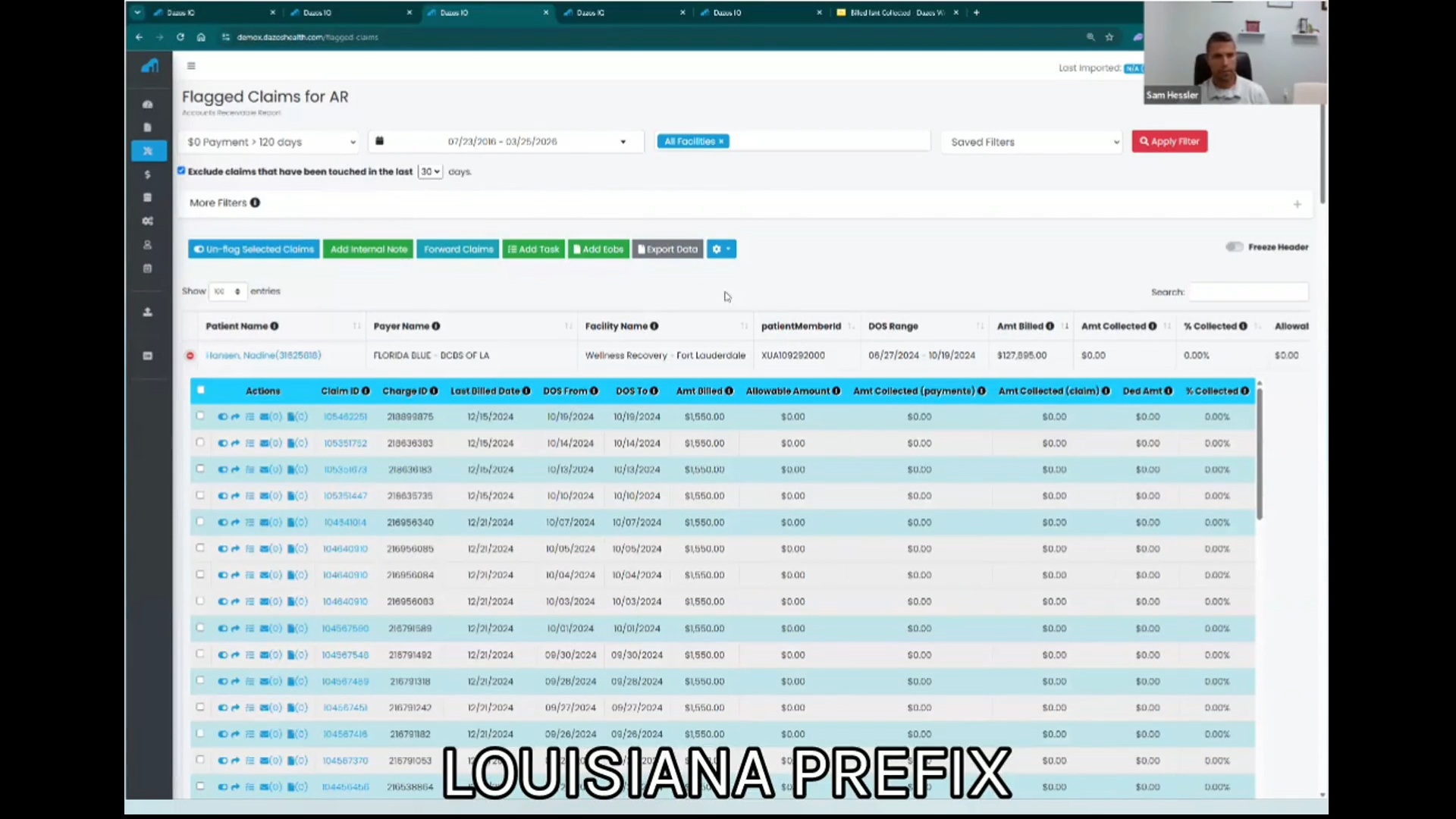
2:36
IQ Demo - Flagged Claims & Workflows

Work only the claims that need attention

Dazos IQ automatically flags denials, underpayments, and unpaid claims. See how to read biller notes, escalate a stuck claim, snooze the rest, and clear your review list down to zero each day.

"Just through working the flagged claims that IQ flags, we collected $937,000 that otherwise would have gone uncollected. That was the difference between profit and loss last year."

Mike ColasuonnoCEO, Provident Health
What You'll Take Away

Four ways to see your revenue clearly

A daily and weekly framework

A clear view of what to look at weekly, not just at month-end once the numbers are already stale.

Real accountability for billing

How to hold a billing team, whether in-house or outsourced, accountable with real data instead of assumptions.

A sharper view of marketing ROI

A new way to think about marketing ROI when reimbursement lags admission by months.

A look at Dazos IQ

See how Dazos IQ uncovers underpaid and unpaid claims, flags denial trends, and ties marketing spend directly to revenue outcomes.


FAQ

Questions From the Session

What does "billed isn't collected" mean?
The amount you bill insurers rarely matches the amount that lands in your account. Panelists described roughly 30% of treatment days going unreimbursed before they had claim-level visibility. Days get billed but denied, underpaid, or lost to timely-filing deadlines. Without daily visibility into what was allowed versus paid, that gap stays invisible until the revenue is gone.
Why do claims get denied even when the care was delivered?
Two causes come up repeatedly: coordination-of-benefits (COB) records that aren't updated, and incorrect authorization forms. For Blue Cross, staff often complete only the home-state AOR form when both the home-state and local forms are required. Fixing COB discipline and auditing AOR forms cut one operator's denials by about 60%.
Why won't my outside billing company chase every claim?
A biller charging 4-5% earns very little on a small or out-of-state claim, so those claims aren't worth their time to pursue. For the provider, though, a few missed high-value days can be the difference between a profitable month and a loss. The incentives don't line up, which is why providers need their own visibility.
What is timely filing and why does it matter so much?
Timely filing is the deadline insurers set for submitting or correcting a claim. Miss it and the revenue is generally gone for good. One operator recovered a large sum in flagged claims in a year but couldn't recover the prior year's misses because they'd aged past timely filing. Catching issues in near-real time keeps claims inside the window.
How much revenue can better claim visibility recover?
Panelists cited real numbers. One organization recovered roughly $937,000 in a year by working flagged claims. Another operator found close to $350,000 within his first 45 days, including claims that weren't being repriced correctly. Results are typically largest in the first 6-12 months.
What's the difference between CPA and ROI for admissions?
Cost per acquisition measures what you spend to get an admission. ROI measures what that admission reimburses. A campaign with a higher CPA can be far more profitable if those patients stay longer and pay more. Total revenue is the metric that matters most, above raw admission counts.
Why does length of stay matter to the bottom line?
One operator's facilities make about 70% of revenue in the back 50% of care, once deductibles and coinsurance are met. Pushing admissions through the door by any means necessary backfires: patients who feel misled leave AMA early, and you lose the high-reimbursement back end. Transparent admissions conversations lead to longer stays and better economics.
How hard is it to get CRM, billing, and marketing data into one place?
Doing it manually meant marrying four or five data sets every time you wanted an update. With Dazos, the CRM becomes the source of record: VoIP, web forms, and calls funnel in, the platform syncs bi-directionally with EMRs, and claim data is pulled from the RCM so one system tracks a patient from first inquiry through the full revenue cycle.
Speakers

Who You'll Hear From

Louis Devaleix headshot

Louis Devaleix

Founder & COO, Dazos
Dazos
Mike Colasuonno headshot

Mike Colasuonno

CEO, Provident Health
Operator
Sam Hessler headshot

Sam Hessler

VP of Sales, Dazos
Dazos
Watch On Demand

Watch Full Session

The complete 45-minute recording, plus the operator Q&A.

Watch the recording