Book a Demo
On Demand Webinar

Stop Managing in the Rearview Mirror: The 7-Day Census Forecast Every Behavioral Health Leader Needs

By the time a census dip reaches your monthly report, it's weeks too late to fix. Leadership tends to decide a step behind, on a week that's already gone.

The data exists but reaching it in time is the hard part. Getting to a specific view means knowing where to look, building it, and refreshing it, so a slipping census or a stalled referral source surfaces late, if at all. A dip you catch on Monday is a staffing and outreach decision you can still make; catch it at month-end and the window has closed. A view that looks ahead changes that, giving leaders room to adjust staffing, beds, and spend while it still counts.

You'll see an executive command center that brings census, cash, missed calls, and marketing performance onto one screen, plus a 7-day census forecast that maps where the week is heading before it starts. Operators who run on it share what it caught early and the decisions it changed, and the session closes with a walkthrough.

This session is built for the leaders responsible for census and revenue, from CEOs and COOs to owners and operators.

Watch the Recording

TL;DR

A Live Operational Command Center

Most behavioral health leaders run on a rear-view report: last month's census, answer rate, and spend, pulled by hand from a few systems. By the time the numbers are built, the census has already moved. An executive dashboard that connects your VoIP, CRM, EMR, and Google Ads gives you a 7-day census forecast, your real missed-call rate, and cost per admit by channel, in seconds. Recreate used it to lift its inbound answer rate from about 75% to roughly 90% and get close to an hour a day back from manual reporting.
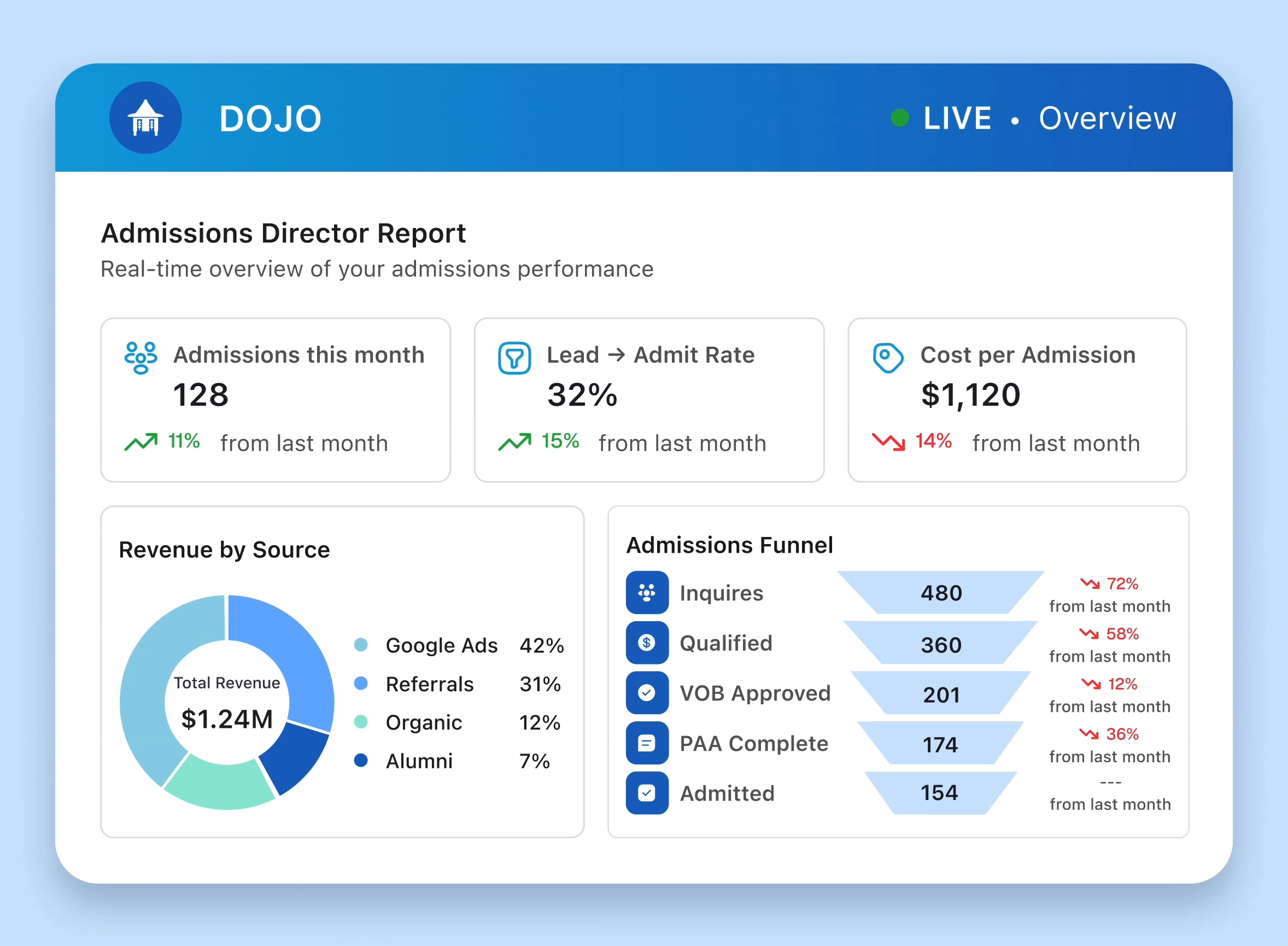
Dojo admissions director report showing admissions this month, lead to admit rate, cost per admission, revenue by source, and the admissions funnel

Sample data shown.

Webinar Highlights

This Program Thought They Answered Every Call

Recreate believed its phones were covered. The numbers showed roughly 1 in 4 inbound calls going unanswered.

Why Behavioral Health Programs Miss Admissions Calls

Where inquiries slip through, and why a monthly report shows the pattern weeks after it cost you admits.

A CRO With No API Experience Built an AI Agent

Liam McElwee of Recreate explains how he built a Slack workflow and an agent with AI help and no developer.

Demo

Track Every Missed Admissions Call

The view that flags missed calls, callback attempts, and first-time callers who never got a call back.

Demo

See Next Week’s Census, Not Last Month’s

A 7-day census forecast built from CRM and EMR data, so staffing and beds move before the dip.

Demo

Cost Per Admit by Channel, Automatically

Google Ads, call tracking, and CRM admits in one view, so spend is measured in admissions instead of clicks.

How Much Time Does a Live Dashboard Save You?

Customers report getting back an hour a day or more once reporting stops being a manual pull.

FAQ
How Long Does It Take to Set Up If We Already Have the Dazos CRM?
Days, not weeks. Sam Hessler said the platform takes minutes to create and about 30 to 45 minutes of mapping, where you set your sources into buckets, map levels of care, and define which stages count as a pending versus committed admit. Liam McElwee said Recreate was live the same day after a 30-to-45-minute call learning the buckets. Tooltips walk you through most of it.
What Does the Dashboard Connect To?
It connects to the systems you already run. Sam Hessler described Dojo pulling from your VoIP or call tracking (CTM, CallRail, and others), your CRM, the EMR your CRM is integrated with for census, and Google Ads. It brings those into one executive view instead of three or four separate dashboards, which is how it surfaces metrics a CRM alone cannot.
How Does It Help With Missed Calls Specifically?
It shows you the calls that slipped and whether anyone followed up. The dashboard flags calls that rang past about 10 seconds, came from a first-time caller, and never got a callback. A CTM or VoIP button takes you straight to the call. It also shows callback detail: how long the callback took, how many attempts were made, and whether the caller was reached. Recreate's answer rate went from about 75% to roughly 90% once the team knew leadership could see it.
Can It Forecast Revenue Too?
Yes. Sam Hessler explained that because the dashboard already has your census, levels of care, and length of stay, it ties a forecasted collection amount to the treatment you are providing, aggregates it, and projects it forward. That average daily revenue view started as a spreadsheet one customer rebuilt by hand every morning. At a census of 250 to 300, Liam McElwee said doing it by hand is not realistic.
Do I Need a Developer to Build Custom Tools on Top of It?
No. Liam McElwee had no API experience a few months before the session. He used the Dazos API developer manual with Claude to build a Slack workflow and then an agent that runs policies and creates opportunities. Sam Hessler's point was that AI removes the step between an operator's idea and a working tool, so you no longer need a developer in the middle to try something.
How Many Hours Does It Save?
Liam McElwee put it at about 45 minutes a day on the daily census alone, and at least an hour a day overall. His PPC reporting went from 10 to 15 minutes to about 5 seconds. He spends the time back on the floor with his admissions team.
How Many Dazos Customers Use Dojo?
About 15 to 20% of the customer base, per Sam Hessler, from an idea that was roughly six months old at the time of the session. He said adoption was showing no signs of slowing.
Sign Up